With daylight saving back and the summer sporting calendar in full swing, community venues across Australia are getting busier after dark. Twilight tennis competitions, pennant bowls, race meetings and training sessions all run on past sunset, and the car parks that serve them stay full long after the last ball is bowled.
For clubs, councils and the electricians who look after them, that raises the same question every year: how do we light this space properly without blowing the budget?
The hidden cost of lighting a venue
Lighting a green, court or car park the traditional way is rarely just the cost of the lights. Cable has to be trenched across playing surfaces and car parks, switchboards often need upgrading to carry the extra load, and once the job is finished the venue pays for every hour the lights are on. For a volunteer committee or a council working to a capital works budget, those extra costs can stall a project for years.
Solar lighting changes the maths. Each pole carries its own panel, battery and controller, so it generates and stores its own energy during the day and runs independently at night. There is no cable to trench, no switchboard to upgrade and no nightly power bill. Poles can go exactly where the light is needed, not just where the power can reach.
Lawn bowls: even light across the whole green
Bowlers need to read the head from the mat, which means light that is even across the green and low in glare. Patchy lighting creates bright spots and dark corners that make it hard to judge weight and line, and harsh glare can be worse than no light at all.
A standard bowling green has a similar footprint to a three court tennis block, which makes it well suited to the same approach Plusrite uses for courts: ORCA-200W solar floodlights on 8 metre poles placed around the perimeter, each aimed to overlap its neighbours so the whole surface is evenly covered. Because each pole is self powered, nothing needs to be trenched through the turf or around the ditch. Clubs can also model the green against the lighting targets their association asks for, as outdoor bowling greens are covered by their own part of the AS 2560 sports lighting series.
Horse and dog racing: keeping race nights running
Racetracks place huge demands on their lighting. The main towers that light the racing surface typically run high output fittings that need to be kept in top condition, and when a single lamp fails it is rarely practical to replace a whole bank.
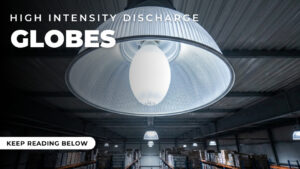
This is where Plusrite’s range covers both sides of the venue. For existing towers, our LED floodlights and range of HID globes, including metal halide and high pressure sodium, keep fittings running without unnecessary capital expenditure. Around the track, solar lights take care of the areas that are often forgotten until someone trips in the dark: stalls and kennels, float and trailer parking, walkways, gates and access roads. These are exactly the spaces where trenching new power is expensive and disruptive, and where a self contained solar light makes the most sense.
Tennis courts: a real three court design
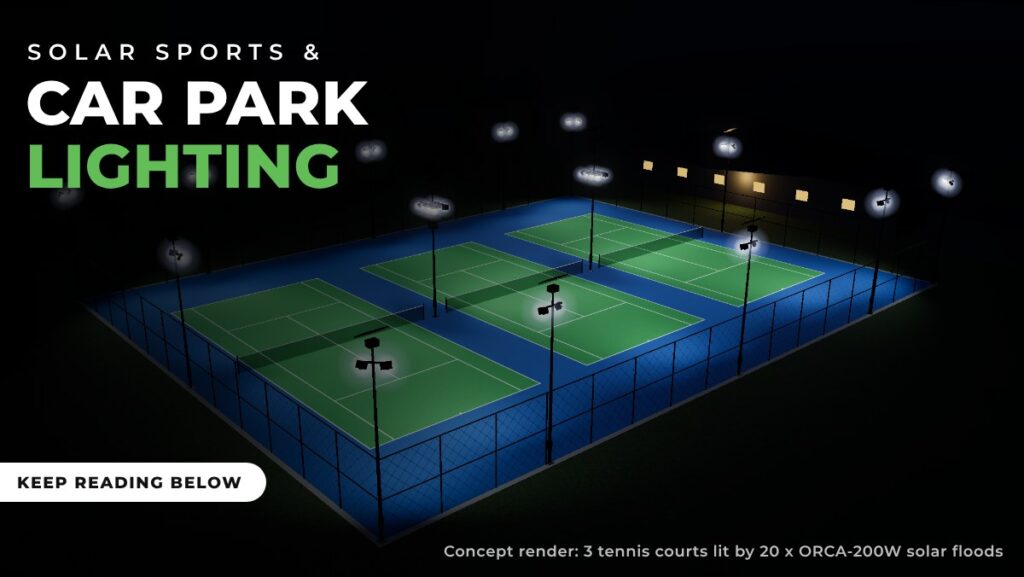
Plusrite recently prepared a lighting concept for a three court block at a local tennis club. The design uses 20 ORCA-200W solar floodlight units, a total of 40 lights, mounted on 14 poles of 8 metres. Twelve perimeter poles each carry one ORCA unit, while the two poles on the net lines between courts carry four units each, with eight floods fanned to light the courts on either side.
The calculated result averages 384 lux across the playing lines of all three courts, comfortably above the 300 lux target, with a uniformity of 0.68. Every court was modelled point by point from the luminaire’s measured photometric file, then turned into a night render so the club could see exactly how the courts would look before committing to the project.
Car parks: smart light that responds to people
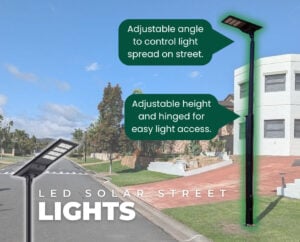
Car parks need reliable light for safety, but they are often empty for long stretches of the night. The Dolphin smart solar street light is designed for exactly this. Each head delivers around 8,000 lumens from a 40 watt LED array, and its Smart Detect motion sensor idles the light at 30% until a person or vehicle approaches, then returns it to full output. That saves stored energy for when it is actually needed.
For a regional council car park, Plusrite designed a layout of 12 Dolphin-40W heads on five new 8 metre hinged poles, using twin and four way adaptors so each pole lights the bays around it. The simulation showed an average of 18.6 lux across the car park, with 97% of the area at or above 7 lux, meeting the PC1 subcategory for high night-time use in AS/NZS 1158.3.1 at full output.
Beyond the venue: roads and intersections
The same thinking applies to the roads leading to a venue. For a rural intersection on a regional road, six ORCA 100W solar street lights on 8.5 metre slip base poles create a continuous band of light across 248 metres of road. A 4G controller runs them at full output for the first four hours after dusk, then at 50% until sunrise, and each light carries enough battery for 60 to 80 hours of autonomy.
See it before you build it
Every one of these projects started the same way: with a site plan or an aerial screenshot. From there, the Plusrite team works out pole positions, mounting heights and aiming angles, calculates the lux levels across the site, and produces a night render that shows what the finished project will look like. It means committees, councils and contractors can make decisions with confidence, and electricians arrive on site with the layout already worked out.
Getting started
Whether you are a club committee planning a lighting upgrade, an electrician quoting on a sports or car park job, a wholesaler supplying the trade, or a council officer scoping a capital works project, Plusrite can help. Send us a site plan or an aerial screenshot of your green, track, court or car park and we will come back with a lighting layout and a quote. Contact the Plusrite Australia team on 03 9708 2552, email sales@plusrite.com.au or visit plusrite.com.au to get started.
EXCELLENT
19 reviews
Posted on Google
Kelly Schill
Katie helped us source a part we needed and couldn't get anywhere, her customer service was amazing and communication excellent throughout the whole process. Will definitely use them in the future and will recommend them to people. Thanks again 👍😊
Posted on Google
Anas Sheriffdeen
Was a smooth process, the order arrived the next day. I got it installed with my electrician in 2 hours. The Charger is working without any issues. The 22kV charger is used for our new EV EQE 350 Mercedes Benz. The Z-Box app that comes with the unit is awesome and easy to setup on the phone.
Posted on Google
Darren Nash
Harness a quarter of the power of the sun for under $400!! These lights are solar powered which is perfect for charging during the day when you don’t need lights and are ready for keeping your camp lit 🔥!!!
The lights are magnetic and can be removed to walk to the car or caravan. These are Awesome lights. Definitely speak to Ross or Warren for your lighting needs. I also bought additionally the Bluetooth speaker and a mozzie light. Good for twilight when cooking.
Posted on Google
Mr T
I purchased an EV charger from these guys last week. The whole experience has been great! Ross, who I think is the owner/manager was super helpful with product knowledge and tips before and after buying the unit. Highly recommended.
Posted on Google
John Allen
We visited their office after viewing video of Plusrite car charger. Ross explained how the charger works and showed us the one fitted at his office that he uses for his E car. We needed it for our Renault E tech. Ross was able to recommend an electrician to install and it works beautifully. Ross is happy to spend time with you and his experience with E cars means he has the answers to the questions you will have. Great product, fair price and really good service.
Posted on Google
Ravi Krishnan
Bought the Plusrite Single Phase charger. Fast shipping. Relatively easy installation ( but no install manual). Z Box app. Works well.
Response to owner- Yes 3 books . 2 for DLB and 1 for Z-Box. Factory must have missed the installation guide but no issue as easy to work out install. Thanks
Posted on Google
Lindsay Wood
Amazing service. After ordering from Michael I expected the lights to take a week to get to Brisbane (like many items I buy from interstate suppliers), but no, these turned up the next business day. Well done.
Posted on Google
Olivia Peacock
Ross and the Plusrite team have the knowledge and expertise to get you the best quality products at a very competitive price. Biggest range of products I’ve seen in Australia. Would recommend.
Posted on Google
Graeme Robinson
This company sells quality lighting equipment.Very happy with my solar lights.Thank you warren and ross.
Posted on Google
Ian Thompson
Bought some BLUE LED Garden Solar lights - cheaper price than I could find elsewhere.
The people at PLUSRITE were prompt and answered all questions - the products arrived very quickly and all are working great.
Highly recommend!
The Australian Government is phasing out High Intensity Discharge lamps by 2030. Discover how Plusrite is helping facility managers keep their existing lights running, allowing you to plan LED upgrades on your own budget and timeline.
Discover how upgrading to commercial solar street and flood lights can significantly lower your property electricity bills. Learn about the financial and operational benefits of off-grid lighting for your Australian business.
Discover how replacing traditional wired fixtures with solar street and flood lights can dramatically reduce your electricity bills, eliminate expensive trenching costs, and provide reliable illumination with minimal ongoing maintenance required across your properties.