For a lot of Australian businesses, the Christmas shutdown is the one stretch of the year when the site goes quiet. Forklifts are parked, the shopping centre car park thins out and the production line stops. That makes it the easiest time to get a lift or an elevated work platform under the high bays and up to the pole tops without getting in anyone’s way, and to replace the HID globes in them.
It is also the best time to look after the high intensity discharge (HID) lighting that is still doing the heavy lifting in warehouses, factories, depots, car parks, sports grounds and streets. In September we explained that the Australian Government is phasing out metal halide and high pressure sodium lamps by 2030, and that Plusrite will keep HID globes on the shelf so existing fittings can keep running. This post is the practical follow-up: a five step checklist to run before the break, so the lights are sorted when everyone comes back.
Step 1: Walk the site after dark
The first job is finding out which fittings actually need attention, and the best way to do that is to walk the site once the lights are on.
High pressure sodium (HPS) lamps have a distinctive way of telling you they are near the end of their life. They start cycling: the lamp lights up, runs for a while, goes out, cools down and then tries to start again. If you see an orange street light or car park light that keeps dropping out and coming back, that is almost always a lamp at the end of its life rather than a fault with the fitting. Left too long, constant cycling also puts extra strain on the ignitor and ballast.
Metal halide lamps fail differently. As they age, they gradually lose brightness, the colour drifts (often towards a pink or green tinge) and they take longer to reach full output after switching on. In a high bay warehouse you will often notice one or two fittings looking dimmer or a different colour from their neighbours.
One thing that is normal and not a fault: after a power interruption, HID lamps need to cool before they can restrike. A metal halide lamp can take several minutes before it comes back on, so do not mark a fitting as faulty just because it stayed dark straight after a blackout.
Make a simple list or a marked up floor plan of every fitting that is cycling, dim, discoloured or out.
Step 2: Read the code on your old HID globes
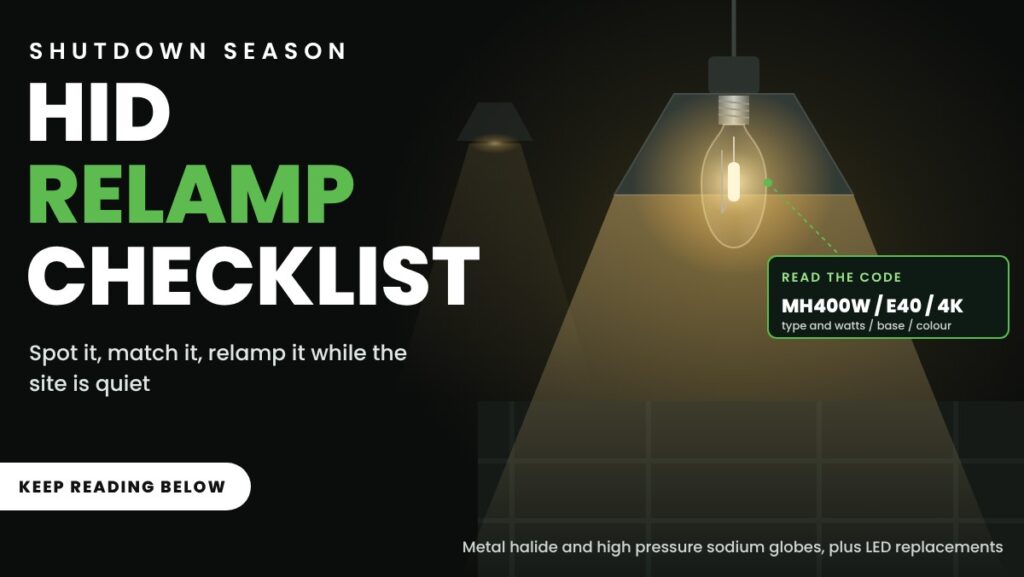
Everything you need to order the right replacement is printed on the lamp itself or on its box. Using one of the metal halide lamps in our range as an example, here is how a typical code breaks down:
MH400W / ED120 / C / U / 4K / E40
MH400W: the lamp type and wattage, in this case metal halide at 400 watts.
ED120: the bulb shape and size.
C: coated glass. Lamps without the C are clear.
U: universal burning position, meaning the lamp can be run base up, base down or horizontal.
4K: colour temperature, 4000K. Match this to the rest of the fittings in the area so the light looks consistent.
E40: the base, in this case a large Edison screw.
High pressure sodium lamps follow similar logic, with the wattage, bulb shape (tubular or elliptical) and base. Ceramic metal halide lamps add a colour code such as 830 (warm 3000K) or 942 (4200K), and US standard lamps often use an E39 base rather than E40.
If the code has worn off or the lamp is already in the bin, a clear photo of the lamp and the fitting’s label is usually enough. Send it to sales@plusrite.com.au and the team will match it for you.
Step 3: Match the gear, not just the globe
An HID lamp is only half of the system. The other half is the control gear: the ballast and, for most lamps, the ignitor. Getting the globe right but the gear wrong leads to short lamp life, poor colour or a lamp that will not start at all.
A few rules of thumb:
Metal halide and HPS are not interchangeable. They run on different ballasts and ignitors, so replace like with like unless the fitting’s label says otherwise.
Pulse start and probe start metal halide need matching ballasts. If your site has US standard fittings, check which type you have before ordering.
Check the fitting label. It usually lists the lamp type and maximum wattage the fitting was designed for.
Open fittings need open rated lamps. If a metal halide fitting has no front glass or lens, use a lamp rated for open fittings. Most metal halide lamps are designed to run inside an enclosed fitting.
Plusrite stocks HID ballasts alongside the globes, so if a fitting has been cycling for a long time or a ballast has failed, you can sort both in the same order.
Step 4: Relamp the group, not just the failure
It is tempting to replace only the lamps that have actually gone out. On a high bay ceiling or a row of pole tops, that usually costs more in the long run.
Lamps that were installed together wear out together. When one in a bank fails, the rest are generally close behind, and each ageing lamp is giving out noticeably less light while drawing much the same power. Spot relamping means booking a lift, an electrician and a shutdown of the area every few weeks as the next lamp goes.
Group relamping replaces every lamp in an area at once, at or before the end of its rated life. The light levels across the area are even again, the colour matches, and the access equipment is only needed once. The Christmas shutdown is the natural time to do it.
If you have metal halide lighting that runs 24 hours a day, seven days a week, lamp manufacturers also recommend switching it off for at least 15 minutes once a week. This reduces the chance of the arc tube failing at the end of its life. Relamping at or before rated life, rather than running lamps until they fail, helps for the same reason.
Safety first: always switch the power off and let the lamp and fitting cool before removing a lamp, as HID lamps run extremely hot. If the outer glass of a lamp is broken, switch it off and replace it straight away. Use the right access equipment for high bays and poles, and have any wiring work done by a licensed electrician.
Step 5: Recycle the old lamps
HID lamps contain a small amount of mercury, so they should never go in the general waste or the recycling bin. Recycling recovers the mercury and other materials for reuse.
There are commercial lamp recyclers across Australia that provide collection boxes and pick ups for businesses. FluoroCycle, the national product stewardship scheme for mercury containing lamps run by Lighting Council Australia, lists participating organisations and recyclers, and the Recycling Near You website has a directory of options. Small businesses with only a few lamps may be able to use their council’s hazardous waste drop-off. A group relamp is a good time to set up a regular collection if you do not have one already.
When it is time to move on
Some fittings will be due for more than a new globe. If you are planning a gradual move to LED, Plusrite’s metal halide LED replacement bulbs are designed to fit common metal halide fittings found in high bay lighting, older street lights and large area lighting. They come in tubular and elliptical shapes in a range of wattages and colour temperatures, so they can sit alongside existing lighting without looking out of place. Tell us the fitting and the lamp code and we will advise on the right replacement and what the changeover involves. Any rewiring should be carried out by a licensed electrician.
The point is that the timing is yours. You can keep proven fittings running with genuine HID replacements, upgrade area by area as budgets allow, or do both.
Who this helps
Facility and property managers: one planned relamp over the shutdown instead of chasing individual failures all year.
Electricians: globes and ballasts from one supplier, matched to the code on the job, with delivery Australia-wide.
Wholesalers: a deep range of metal halide, ceramic metal halide and high pressure sodium lamps for the counter, with trade pricing available on request.
Councils and government: replacement lamps for street, park and car park lighting that is still in service, plus LED options when the budget allows.
Getting started
Send us the code from the old lamp, or a photo of the lamp and the fitting label, and we will match it and send you a quote. Order early so stock is on site before your shutdown begins.
Katie helped us source a part we needed and couldn't get anywhere, her customer service was amazing and communication excellent throughout the whole process. Will definitely use them in the future and will recommend them to people. Thanks again 👍😊
Posted on Google
Anas Sheriffdeen
Was a smooth process, the order arrived the next day. I got it installed with my electrician in 2 hours. The Charger is working without any issues. The 22kV charger is used for our new EV EQE 350 Mercedes Benz. The Z-Box app that comes with the unit is awesome and easy to setup on the phone.
Posted on Google
Darren Nash
Harness a quarter of the power of the sun for under $400!! These lights are solar powered which is perfect for charging during the day when you don’t need lights and are ready for keeping your camp lit 🔥!!!
The lights are magnetic and can be removed to walk to the car or caravan. These are Awesome lights. Definitely speak to Ross or Warren for your lighting needs. I also bought additionally the Bluetooth speaker and a mozzie light. Good for twilight when cooking.
Posted on Google
Mr T
I purchased an EV charger from these guys last week. The whole experience has been great! Ross, who I think is the owner/manager was super helpful with product knowledge and tips before and after buying the unit. Highly recommended.
Posted on Google
John Allen
We visited their office after viewing video of Plusrite car charger. Ross explained how the charger works and showed us the one fitted at his office that he uses for his E car. We needed it for our Renault E tech. Ross was able to recommend an electrician to install and it works beautifully. Ross is happy to spend time with you and his experience with E cars means he has the answers to the questions you will have. Great product, fair price and really good service.
Posted on Google
Ravi Krishnan
Bought the Plusrite Single Phase charger. Fast shipping. Relatively easy installation ( but no install manual). Z Box app. Works well.
Response to owner- Yes 3 books . 2 for DLB and 1 for Z-Box. Factory must have missed the installation guide but no issue as easy to work out install. Thanks
Posted on Google
Lindsay Wood
Amazing service. After ordering from Michael I expected the lights to take a week to get to Brisbane (like many items I buy from interstate suppliers), but no, these turned up the next business day. Well done.
Posted on Google
Olivia Peacock
Ross and the Plusrite team have the knowledge and expertise to get you the best quality products at a very competitive price. Biggest range of products I’ve seen in Australia. Would recommend.
Posted on Google
Graeme Robinson
This company sells quality lighting equipment.Very happy with my solar lights.Thank you warren and ross.
Posted on Google
Ian Thompson
Bought some BLUE LED Garden Solar lights - cheaper price than I could find elsewhere.
The people at PLUSRITE were prompt and answered all questions - the products arrived very quickly and all are working great.
Highly recommend!
From twilight tennis to pennant bowls and race nights, Australian venues are busier than ever after sunset. Here is how Plusrite’s solar floodlights and smart solar street lights light greens, tracks, courts and car parks without trenching cable or adding to the power bill.
The Australian Government is phasing out High Intensity Discharge lamps by 2030. Discover how Plusrite is helping facility managers keep their existing lights running, allowing you to plan LED upgrades on your own budget and timeline.
Discover how upgrading to commercial solar street and flood lights can significantly lower your property electricity bills. Learn about the financial and operational benefits of off-grid lighting for your Australian business.